A root canal saves your natural tooth and is almost always the better first choice. A bridge replaces a missing tooth but comes with hidden biological costs to neighboring teeth that most patients never hear about. Understanding the physics and biology of both options changes how you’ll approach this decision. Whether you’re exploring restorative dentistry options or trying to avoid unnecessary procedures, this guide will help you make a more informed choice.
 The “Three-Tooth Solution to a One-Tooth Problem” — What Bridges Actually Cost Your Healthy Teeth
Most patients come in thinking a bridge is the simpler path. For Encino-area patients, I understand why. It sounds more straightforward than a root canal. But there’s a biological cost to bridges that rarely gets discussed, and I think you deserve to know it upfront.
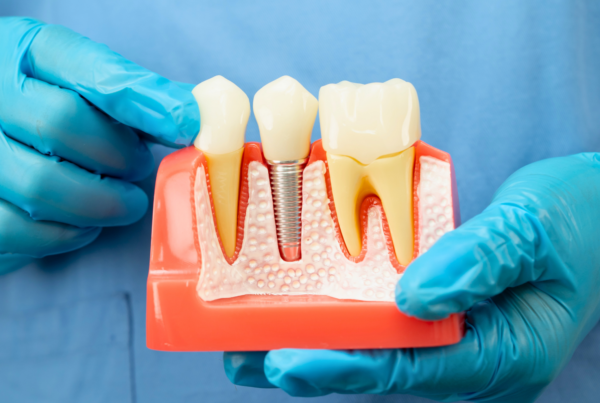
A traditional bridge works by grinding down the two healthy teeth on either side of the gap — the abutment teeth — and cementing crowns over them to anchor the false tooth in between. If those neighboring teeth are “virgin teeth” (no fillings, no prior work), you’re permanently removing healthy enamel to solve a one-tooth problem. That enamel never grows back.
Here’s why that matters clinically: preparing a healthy tooth for a crown involves significant drilling. That heat and vibration can traumatize the nerve inside the tooth. In some cases, a perfectly healthy neighboring tooth develops irreversible pulpitis afterward — meaning it eventually needs its own root canal. I call this the endodontic domino effect. You came in needing one procedure; you leave needing three.
As the American Academy of Periodontology notes, a tooth-supported bridge requires that adjacent teeth be ground down to support the cemented structure — a compromise that doesn’t apply to implants or root canal-treated natural teeth.
Compare that to a root canal: the natural tooth structure stays intact. The neighboring teeth are never touched. From a biological standpoint, saving your own tooth is almost always the less invasive long-term choice.
Who Isn’t a Candidate for a Bridge — Including a Physics Reason Most Dentists Don’t Mention
Obvious disqualifiers include active gum disease, insufficient bone, or missing teeth that aren’t adjacent to healthy abutments. But there’s a mechanical reason that gets almost no attention: Ante’s Law.
Ante’s Law is a clinical principle stating that the combined root surface area of the anchor teeth must be equal to or greater than the root surface area of the teeth being replaced by the bridge. In plain terms: the anchor teeth have to be physically strong enough to carry the extra load.
When they’re not — because of bone loss, short roots, or an unfavorable root-to-crown ratio — the bridge acts as a lever. Chewing forces get multiplied at the anchor points, and over time, those teeth can loosen or fracture. The bridge doesn’t fail dramatically; it fails slowly, taking healthy teeth with it.
You can get a rough sense of your own situation by looking at your X-rays with your dentist. If the roots look short relative to the crowns, or if there’s visible bone loss around the anchor teeth, a bridge may be putting too much mechanical stress on a compromised foundation. Patients with crowns and veneers already in place should pay particular attention to how those restorations interact with any proposed bridge design.
According to the Mayo Clinic, root canal treatment repairs and saves a badly damaged or infected tooth instead of removing it — preserving the root structure that makes Ante’s Law a non-issue in the first place.
Can You Get a Root Canal Under an Existing Bridge? The Vibration Risk Nobody Warns You About
Yes — technically, a dentist or endodontist can drill an access hole through a bridge to perform a root canal on the tooth underneath. But there’s a critical complication that most online resources skip entirely.
Drilling through a porcelain-fused-to-metal bridge generates significant heat and vibration. That vibration travels through the porcelain and can create micro-fractures in the porcelain-to-metal bond. You might complete the root canal successfully, only to have the porcelain facade chip or delaminate six months later — because the structural integrity of the bridge was compromised during the access procedure.
This means the root canal “worked,” but now you need a new bridge anyway.
If you’re in this situation, here’s what I recommend monitoring after the procedure:
- Run your tongue along the bridge surface regularly for any rough edges or chips
- Report any sensitivity to temperature — it can indicate micro-crack propagation
- Get a follow-up X-ray at 6 months to confirm the root canal is healing and the bridge margins are still sealed
- Discuss bridge lifespan honestly with your dentist — a drilled bridge has a shorter predictable lifespan than an untouched one
The broader lesson: this scenario is almost always preventable. The American Association of Endodontists explains that root canal treatment preserves the natural tooth and avoids the extensive restorative work — like a bridge — that follows extraction. Treating the tooth before it’s covered by a bridge keeps all your options cleaner. If a dental emergency has accelerated your timeline, emergency dentistry services can help you address urgent issues before they limit your options further.
Root Canal vs. Extraction and Implant — When Saving the Tooth Isn’t Possible
Sometimes the tooth is too far gone. Deep fractures, severe bone loss around the root, or a failed previous root canal can make extraction the only realistic option. In those cases, an implant is generally my preferred replacement — not a bridge.
A Healthline overview of root canal vs. implant options notes that after extraction, you may need an implant, bridge, or partial denture to fill the gap, with implant timing varying from immediate placement to several months depending on bone healing.
Implants don’t require grinding down neighboring teeth. They integrate with the jawbone, which helps prevent the bone resorption that follows extraction. According to Cleveland Clinic, root canals are common, successful, and help save the natural tooth — but when that’s not possible, the replacement decision matters just as much. In cases where implant failure becomes a concern down the road, laser treatment for failing implants offers a modern option for salvaging the investment.
My general hierarchy for patients: root canal first, implant second, bridge third. That order reflects biological cost, long-term function, and what I’d choose for myself.
Come Talk to Us in Encino
If you’re weighing a root canal against a bridge — or you’ve been told you need one and aren’t sure about the other — I’d encourage you to get a full conversation before committing to either. At Encino Dental Studio, we take time to review your X-rays, explain your root surface area and bone levels honestly, and give you options that fit your actual clinical situation. Our preventative dentistry approach means we always look for ways to protect your healthy teeth before recommending any procedure that puts them at risk. We serve patients throughout Encino, Tarzana, Sherman Oaks, and Studio City. Reach out and let’s figure out the right path for your tooth — and your neighboring teeth.
Medical disclaimer: This article is for informational purposes only and does not constitute dental or medical advice. Always consult a licensed dental professional for diagnosis and treatment recommendations specific to your situation.