Reviewed by Dr. Amir H. Jamsheed, DDS
Root canals and extractions both use local anesthesia, but their pain profiles differ in timing and intensity. Modern dentistry also offers alternatives to full root canals for borderline cases — and understanding the structural limits of a tooth explains why some seemingly painless teeth suddenly become unsavable.
 Why “Too Late for a Root Canal” Has Nothing to Do With Pain
This surprises a lot of patients: the tooth that qualifies for extraction is often the one that stopped hurting.
When pulpal infection advances far enough, the nerve dies. Pain disappears. Patients assume the problem resolved on its own. What’s actually happening is that decay continues migrating silently — and often downward, below the gumline. The real clinical point of no return isn’t infection severity. It’s a structural measurement called the ferrule effect.
To hold a crown after root canal therapy, a tooth needs roughly 1.5–2.0mm of sound, vertical tooth structure above the bone crest (the “ferrule height”). Once decay or fracture destroys that margin, a crown has nothing stable to grip. Biological width — the natural seal of gum tissue to tooth — gets invaded, and the crown-to-root ratio collapses. At that point, extraction becomes mandatory regardless of how cleanly the canals could be cleaned.
As Harvard Health explains, untreated pulp infection spreads into the surrounding bone — but the quiet, painless phase of necrosis is exactly when subgingival decay does the most structural damage. A tooth can go from “savable” to “unsavable” during the months a patient waits because it stopped hurting.
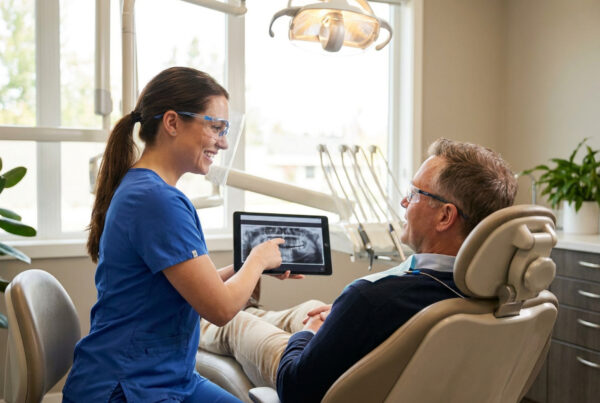
This is why early evaluation matters more than pain level. Discover real habits and care that keep your teeth healthy in Encino CA — X-rays reveal margin loss that no symptom ever announces.
The Real Pain Comparison: Procedural Risk vs. Post-Procedural Risk
The blanket claim that “both procedures are painless with anesthesia” is incomplete — and it alienates patients who’ve experienced the exceptions.
Root canal procedural pain is most unpredictable with mandibular molars during acute irreversible pulpitis. Severe pulpal inflammation drops tissue pH, and standard lidocaine inferior alveolar nerve blocks work poorly in acidic environments. The anesthetic simply doesn’t penetrate as effectively. Dentists managing this scenario typically use buffered anesthetics, supplemental periodontal ligament (PDL) injections, or intraosseous delivery to achieve adequate numbness. Pre-operative NSAID regimens (taken before the appointment, not after) can also reduce prostaglandin-driven inflammation enough to improve block efficacy.
According to Healthline, post-root canal sensitivity is normal for a few days but should decrease steadily — not spike. Worsening pain after day three warrants a follow-up.
Extraction post-procedural pain follows a different curve. The procedure itself is often straightforward under local anesthesia, but days three through five carry the risk of alveolar osteitis (dry socket) — where the blood clot breaks down prematurely, exposing raw bone to oral bacteria. This produces a deep, radiating pain that over-the-counter medications rarely fully control. Smokers, patients on oral contraceptives, and those with difficult surgical extractions face elevated risk. If a dental emergency arises, emergency dentistry services are available to address urgent situations before they worsen.
Penn Dental Medicine notes that patients who choose root canal treatment are six times more likely to describe the experience as painless than patients who choose extraction — a meaningful difference in real-world outcomes.
The summary: root canal procedural pain risk is highest during the appointment for acutely infected teeth; extraction pain risk peaks days later and can be harder to manage at home.
Why Dentists Actively Try to Avoid Full Root Canals
The popular assumption is that dentists avoid root canals because patients fear them. The clinical reality is more nuanced — modern endodontics has developed legitimate biological reasons to preserve living pulp whenever possible.
A tooth with living pulp retains proprioception — the subtle pressure feedback that tells your jaw how hard to bite. A root-canal-treated tooth loses that sensory function permanently. It also becomes more brittle over time without the pulp’s hydrating influence on dentin. Learn the uses and benefits of restorative dentistry in Encino CA to understand how modern techniques help preserve tooth structure and function.
For borderline cases where pulp exposure is small, contained, and shows no signs of irreversible inflammation, two procedures can preserve the living pulp entirely:
- Direct pulp capping — a bioceramic material (MTA or Biodentine) is placed directly over the exposed pulp, creating a mineral barrier that promotes tissue repair without removal
- Cvek partial pulpotomy — only the inflamed coronal pulp tissue is removed, preserving the healthy radicular pulp below
A Healthline overview of root canal alternatives outlines these vital pulp therapy options and their candidacy criteria.
The clinical test that determines eligibility is straightforward: after exposure, the dentist applies sodium hypochlorite to the pulp and monitors for hemostasis. If bleeding stops within approximately five minutes and the tissue appears healthy, vital pulp therapy is viable. Persistent or uncontrolled bleeding signals irreversible pulpitis — and a full pulpectomy becomes necessary. When gum tissue is also involved, laser gum disease therapy can address underlying periodontal issues that complicate treatment planning.
WebMD’s root canal overview reinforces that pulp removal becomes unavoidable once bacterial invasion has progressed beyond the point of tissue recovery.
Once a root canal is completed, protecting the tooth with a well-fitted restoration is essential — understanding dental crowns in Encino CA can help patients make informed decisions about the best way to restore and protect a treated tooth long-term.
What This Means for Encino and San Fernando Valley Patients
If you’re in Encino, Tarzana, Sherman Oaks, or Studio City and you’re weighing these options — or wondering whether your window for treatment is still open — the most important step is a current X-ray and clinical exam. Pain level alone is not a reliable guide. A tooth that stopped hurting may be closer to extraction than one that’s actively sensitive.
Encino Dental Studio evaluates patients for root canal candidacy, vital pulp therapy, and extraction planning. Contact us to schedule a consultation and get a clear picture of your options before structural margins make the decision for you.
Medical disclaimer: This article is for informational purposes only and does not constitute dental or medical advice. Always consult a licensed dental professional for diagnosis and treatment recommendations specific to your condition.