Reviewed by Dr. Amir H. Jamsheed, DDS
Bridges and implants both replace missing teeth effectively, but the right answer depends on the condition of your neighboring teeth, your timeline, and how you plan to manage your dental benefits. There’s no universal winner — only the right fit for your specific situation.
 The Adjacent Tooth Rule: The Tiebreaker Most Guides Ignore
Most comparison articles treat your missing tooth as if it exists in isolation. It doesn’t. The condition of the teeth on either side is often the single most important clinical factor in this decision.
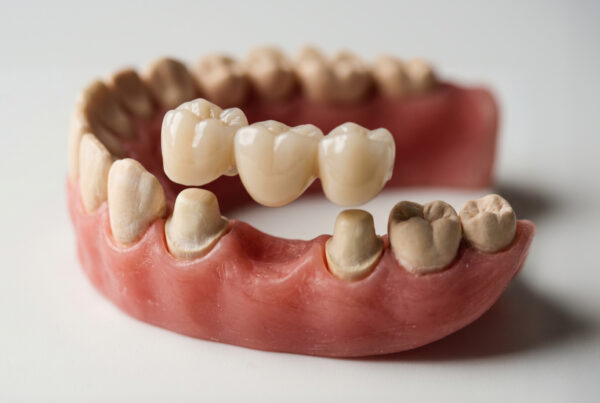
Here’s why it matters: a traditional dental bridge works by crowning the two teeth flanking the gap, then suspending an artificial tooth (pontic) between them. According to WebMD, those anchor teeth — called abutment teeth — must be shaped down to accept the crowns. That shaping is irreversible.
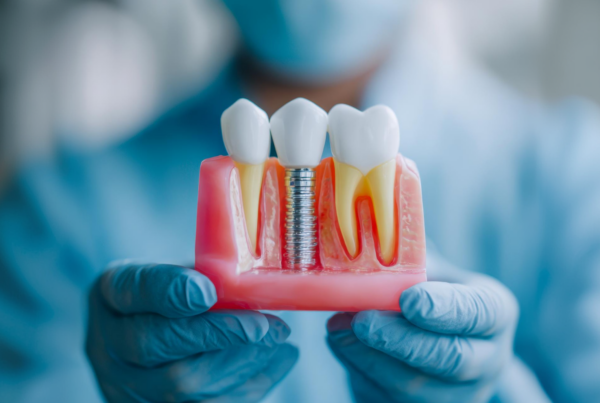
If your neighboring teeth are healthy and untouched (“virgin” teeth), shaving their enamel creates permanent structural damage to teeth that didn’t need intervention in the first place. In that scenario, a single implant protects everything around it. It stands independently, requires no alteration of adjacent teeth, and a Healthline overview confirms implants carry a 10-year success rate above 96%. If you’re weighing your options, it helps to learn the uses and benefits of restorative dentistry in Encino CA before committing to a treatment plan.
But the calculus flips entirely when neighboring teeth already have large fillings, existing crowns, or need root canals. At that point, a bridge becomes a cost-efficient 3-in-1 restorative procedure — you’re restoring the anchor teeth and replacing the missing tooth in a single treatment plan. Crowning teeth that already require crowns isn’t a sacrifice. It’s strategic.
Use this as your mental framework:
- Neighboring teeth are healthy? → Implant protects enamel and avoids unnecessary intervention.
- Neighboring teeth already need crowns or are heavily restored? → Bridge solves multiple problems simultaneously.
This single question resolves the debate faster than any general comparison chart.
The 15-Year Failure Cascade: What Happens When a Bridge Breaks Down
Standard articles note that implants “last longer” than bridges and leave it there. That understates the real difference considerably.
Research published on NCBI shows dental bridges in adults with natural tooth support have high survival rates — but when they do fail, the failure mode is uniquely costly. Bridges typically fail because of recurrent decay forming beneath the crowns on the abutment teeth. By the time that decay is detected, the anchor teeth are often compromised beyond saving.
The result: a patient who originally lost one tooth now faces extraction of two additional teeth, potential bone grafting, and a multi-implant reconstruction. A single-tooth problem becomes a three-tooth surgical event.
Implant crowns also wear over time and may need replacement, but the titanium root itself typically remains intact. You’re replacing the crown — not excavating the foundation. Understanding dental crowns in Encino CA can help clarify what’s involved in both bridge and implant restorations at the crown level.
This distinction matters enormously for long-term planning. A bridge may feel like the simpler path today. Over a 15-to-20-year horizon, the revision pathway for a failed bridge is substantially more invasive and disruptive than any implant maintenance scenario.
Using the Implant Timeline to Your Advantage
One of the most practical and consistently overlooked points in this conversation: the multi-month osseointegration process for implants isn’t just a waiting period — it’s a financial planning window.
Dental implant placement unfolds in distinct phases separated by months of healing. That timeline creates a real opportunity to split treatment across two calendar benefit years, using your annual insurance maximum twice.
A general approach looks like this:
- Late in the calendar year — Complete the extraction and any bone grafting. Submit that phase to insurance and exhaust your current year’s maximum.
- Early in the following year — Place the implant fixture and crown. A fresh annual maximum is now available.
A Healthline comparison guide confirms that bridges are more likely to receive insurance coverage upfront, but this phased billing strategy can significantly close that gap for implants. You can also discover laser treatment for dental implants in Encino CA to understand how advanced techniques may affect your treatment timeline and outcomes. Coordinate this approach deliberately with your dentist and insurance coordinator before scheduling begins.
Bridge or Implant for a Single Missing Tooth: The Practical Summary
For one missing tooth specifically, implants have become the clinical standard in most cases — according to WebMD’s dental bridge overview, bridges generally last 5 to 15 years before requiring replacement, while implants routinely exceed that window.
That said, implants require adequate jawbone density, a healing period of six to twelve months, and a patient who can undergo minor oral surgery. Bridges remain appropriate when:
- Surgery isn’t medically viable
- Adjacent teeth already need crowns
- The missing tooth needs replacement faster than an implant timeline allows
Neither option is universally superior. The best choice is the one that accounts for your bone health, your neighboring teeth, your timeline, and how your treatment phases interact with your annual benefits. Exploring your cosmetic dentistry options alongside restorative choices can also help you achieve the outcome you’re looking for.
Ready to Figure Out Which Option Is Right for You?
Encino Dental Studio serves patients throughout Encino and the greater San Fernando Valley, including Sherman Oaks, Tarzana, and Studio City. Dr. Amir H. Jamsheed, DDS evaluates each case individually — because the bridge vs. implant decision deserves a real clinical conversation, not a generic answer. Contact us to schedule a consultation.
Medical disclaimer: This article is for informational purposes only and does not constitute medical or dental advice. Always consult a licensed dental professional for diagnosis and treatment recommendations specific to your situation.